The Enduring Echo: How Ancient Greek Philosophy Still Shapes Our World
Have you ever stopped to wonder where our ideas about democracy, justice, or the pursuit of a virtuous life truly come from? The answers often lead us back to a rocky peninsula in the Mediterranean, a place where, over two millennia ago, a handful of thinkers laid the foundation for Western civilization. Ancient Greek philosophy is not just a relic of the past; it is a living, breathing framework that continues to influence everything from our legal systems to our personal quest for happiness. At its core, this philosophy was a profound invitation to think critically, question everything, and seek a deeper understanding of ourselves and the world. Let’s explore the timeless wisdom of three of its most influential figures—Socrates, Plato, and Aristotle—and see how their ideas still resonate today.
Socrates: The Power of the Question
“The unexamined life is not worth living.” This famous dictum, attributed to Socrates, encapsulates the essence of his revolutionary approach. Unlike the thinkers who came before him, Socrates didn’t seek to understand the universe; he sought to understand human beings. He believed that true wisdom came from recognizing one’s own ignorance, not from a claim to knowledge. His method—now known as the Socratic Method—was a simple yet powerful tool: a process of relentless questioning designed to expose hidden assumptions, challenge conventional beliefs, and guide individuals toward their own truth.
Socrates never wrote a book; his teachings were passed down through his students, most notably Plato. His influence, however, is immense. His method is the cornerstone of modern education, law, and critical thinking. In a law school classroom, a professor might use Socratic questioning to force students to defend their reasoning. In a business meeting, a leader might use it to uncover flaws in a plan. In our personal lives, we can use it to challenge our own biases and assumptions. Socrates taught us that the path to knowledge isn’t about finding answers but about having the courage to ask the right questions.
Plato: Seeking a Higher Truth
Socrates’ most famous student, Plato, took his mentor’s ideas in a more metaphysical direction. Plato was a profound idealist, believing that the physical world we perceive is merely a shadow of a more perfect, eternal reality. This reality, which he called the Theory of Forms, posited that for every object or concept we see (a beautiful painting, a just act), there exists a perfect, unchanging archetype in a transcendent realm. The chair you’re sitting on is just an imperfect copy of the perfect ‘Form of the Chair.’
This concept, vividly illustrated in his famous Allegory of the Cave, has had a monumental impact on philosophy, art, and religion. It encourages us to look beyond superficial appearances to a higher, more fundamental truth. In a modern context, this quest for the ideal influences our pursuit of perfection in everything from scientific theories to ethical principles. Plato’s vision of a society governed by philosopher-kings in his book The Republic also laid the groundwork for centuries of political philosophy, grappling with fundamental questions about justice, governance, and the ideal state. His work reminds us that while the physical world is flawed, the pursuit of a higher truth is a noble and necessary human endeavor.
Aristotle: The Path to Flourishing
Aristotle, a student of Plato, was a pragmatist who brought philosophy down to earth. While he respected his teacher’s work, he believed that true understanding came not from abstract ideas but from direct observation and empirical evidence. His approach laid the foundation for modern scientific methodology and logic. However, his most enduring legacy lies in ethics and the pursuit of a good life.
For Aristotle, the ultimate goal of human life was not just happiness, but Eudaimonia—a state of flourishing or living well. He argued that we achieve this through virtue, which he defined through the Doctrine of the Golden Mean. According to this principle, virtue is the perfect balance between two extremes of a character trait. For example, courage is the mean between recklessness and cowardice. Generosity is the mean between wastefulness and stinginess. This practical, balanced approach to life offers a clear roadmap for personal growth and ethical behavior. It’s a philosophy that we see echoed in modern psychology, mindfulness, and the constant search for balance in a chaotic world. Aristotle teaches us that fulfillment isn’t an external reward; it’s an active process of cultivating virtues and living in harmony with our rational nature.
A Living Legacy
Centuries later, the questions posed by Socrates, the ideals envisioned by Plato, and the practical wisdom of Aristotle remain as relevant as ever. Their ideas are not confined to dusty tomes in a library; they are embedded in the very fabric of our society and our way of thinking. They remind us of the power of critical inquiry, the pursuit of ideals, and the importance of living a life of virtue. The echo of ancient Greek philosophy is all around us—we just need to listen.
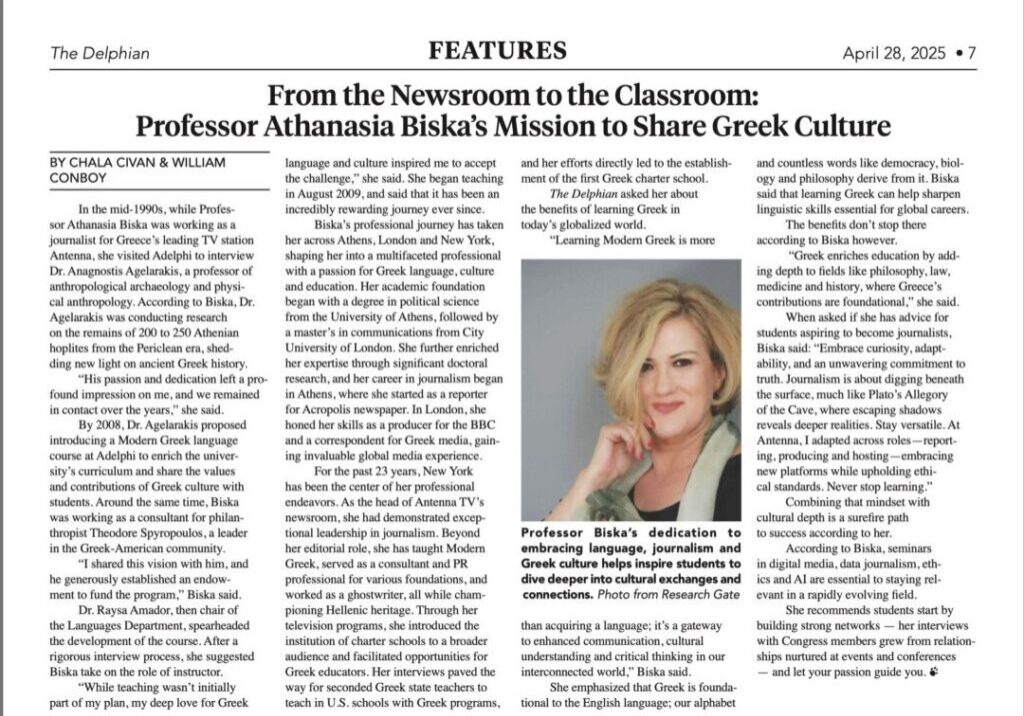
Have questions or want to discuss a collaboration? Contact Athanasia Biska today.
You Might Also Like